Loops, Graphs, and the Layer That Matters
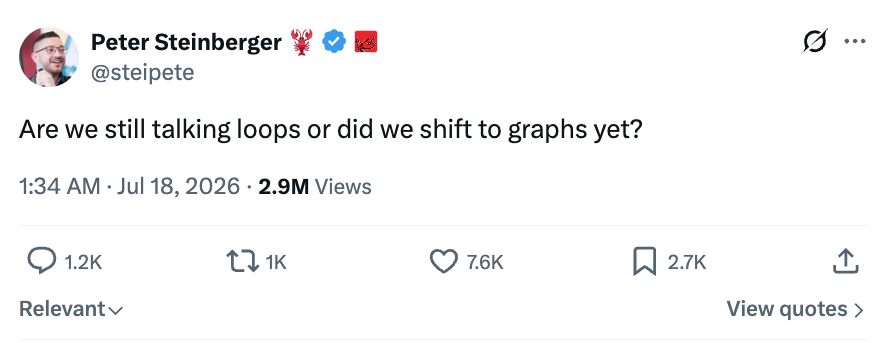
The timeline spent July arguing about whether we moved from loop engineering to graph engineering. One post asked "are we still talking loops or did we shift to graphs yet?" and pulled half a million views. Within a day there was a manifesto, a backlash, and a wave of guides teaching the new discipline. Before that it was loop engineering. Before that, context engineering. Before that, prompt engineering.
Four namings in three years. Each one describes the layer of scaffolding one level further out from the model. Each one arrives with the claim that the previous layer is obsolete. Each one is real work, and none of them is a paradigm.
Here is the pattern worth noticing: the industry keeps inventing disciplines for the space between the model and the backend. That space keeps generating new disciplines because it keeps generating new pain, and it keeps generating new pain because of the paradigm underneath it. The agent scaffolding is its own world, separate from the system it acts on, integrated by hand. Every year the scaffolding gets a new floor, the floor gets a name, and the name gets a course.
- Floor 1: prompt engineering (2023)
- Floor 2: context engineering (2024)
- Floor 3: loop engineering (2025-26)
- Floor 4: graph engineering (July 2026)
What loops and graphs are
Strip the vocabulary and both terms are describing prompts and patterns.
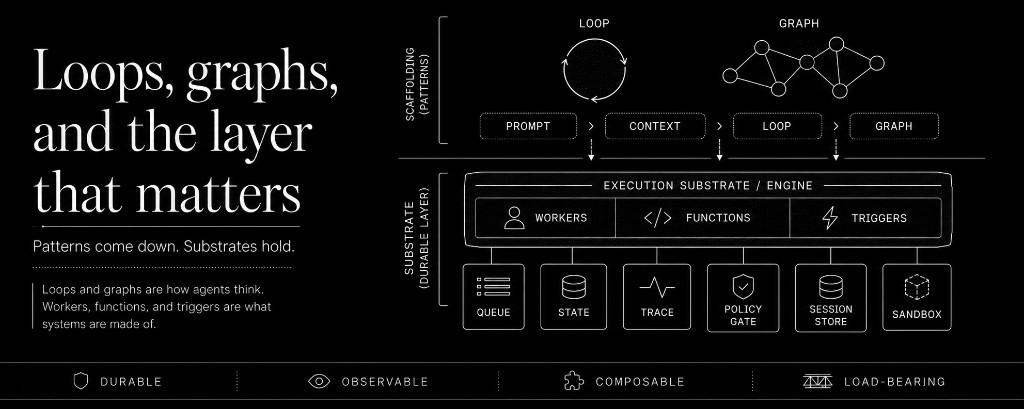
A loop is one agent's cycle: plan, act, observe, repeat until a stop condition. The engineering is the verifier and the stop condition. A graph is several of those cycles integrated together: specialized nodes, routing edges, state passed between them. A loop is just a graph with one node. Neither is new. State machines and DAG orchestration have run production systems for decades. What happened in July is that the pattern got a new name, and the new name got a new market.
None of this is a criticism of the patterns. Fan-out across parallel researchers and fan-in to a reviewer with a fresh context is a real improvement over one agent drowning in its own transcript. Explicit routing you can read as a diagram is better than control flow you reconstruct from a log. These are good patterns. We use them.
The criticism is of the frame. Loop engineering and graph engineering present the shape of the agent's reasoning as the load-bearing engineering decision. It is not. The shape is the easy part, and it is disposable. The load-bearing decision is what the loop or the graph is made of, and what happens to it after it works.
Patterns come down. Substrates hold.
At iii, we have been reducing all patterns to a few core primitives. Here is what building an automation looks like when you focus on the engineering decisions and business logic instead of the shape of the agent's reasoning.
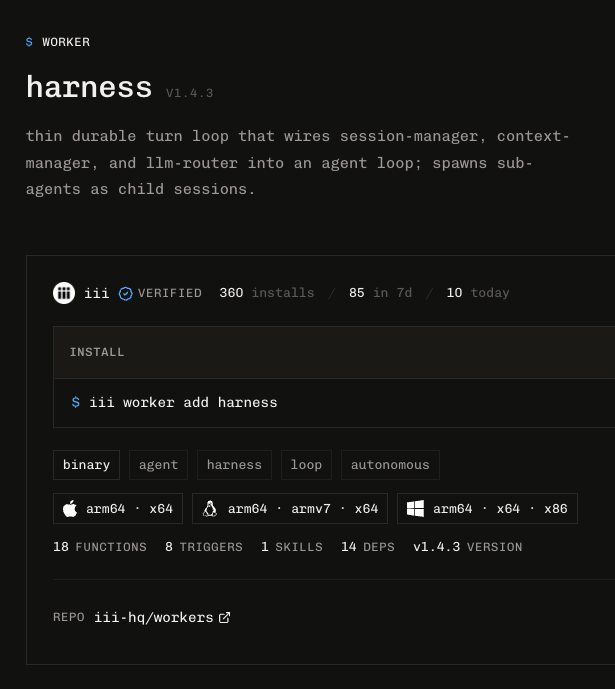
You work with our harness. Our harness is what you'd expect: the turn orchestrator, the model providers, the policy gate, the session store, the sandbox. You describe the job. The agent runs it, in whatever shape the job needs. Sometimes that shape is a loop. Sometimes it fans out and joins. The difference is you are not designing the topology. You are working the problem with the agent, in a session, against a real live system. The same system that you can deploy later.
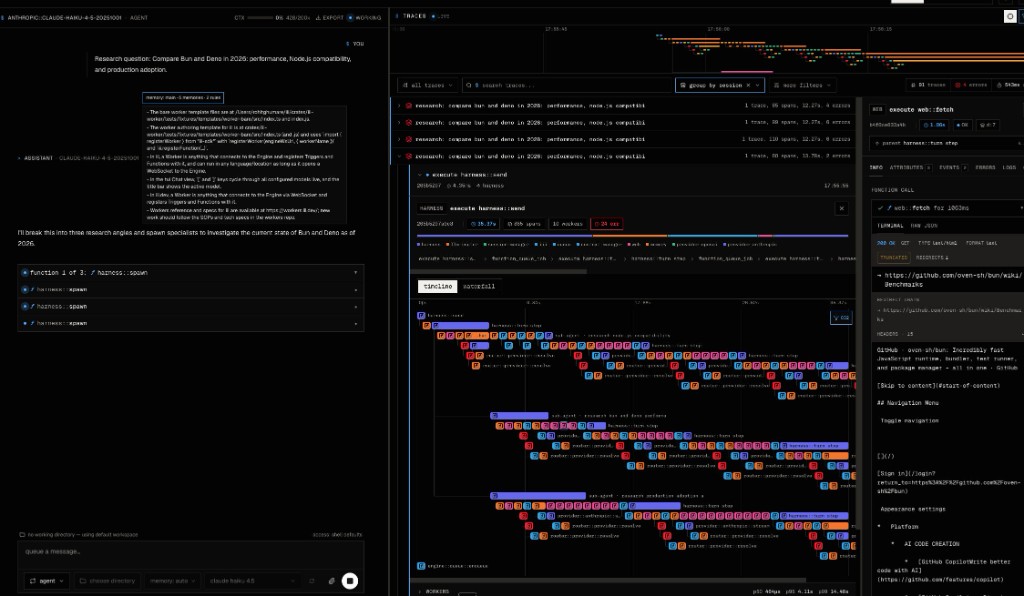
Every step of that session is contained inside what we call the engine. Every function call the agent makes is a span on one trace. Every tool it touches is a worker (aka service) in the open source catalog at workers.iii.dev. The session chat is the design conversation and the trace is the execution record, and they are all unified over the same base system.
Importantly you get to keep this work long term. Most loops are designed to be disposed of along with your token budget. In iii's case, once your loop works, you turn it into permanent workers and functions. The session showed you the shape: these three calls in sequence, this fan-out, this check before this write. That shape becomes reusable functions and triggers (aka events). The loop the agent ran becomes a durable subscriber on a queue topic. The fan-out becomes parallel function calls. The verification step becomes a policy gate function. The one-off session becomes a permanent capability of the system, made of the same primitives as everything else on the iii engine.
At no point in that workflow did "loop engineering" or "graph engineering" appear as a discipline. The loop was how the agent happened to traverse the problem. The graph is the reusable workers and functions it produced. Both were inherent properties of the system. The work products are functions, triggers, and workers, and those can be used long after the pattern that discovered them is gone.
Why the disciplines keep multiplying everywhere else
The reason loop engineering and graph engineering feel like real disciplines on other stacks is that on those stacks, the scaffolding is load-bearing.
When the agent framework is its own world, separate from the backend, the topology is all you have. The graph is the system, because the graph is the only place where control flow, state hand-off, retries, and observability exist for the agent. Designing it feels like engineering because it is engineering, of the same kind that already exists: transport, schema, discovery, retry, trace propagation. The agent stack is re-deriving distributed systems, one named discipline per year, inside a walled garden that is separate from the systems that already solved this.
That is the paradigm problem, and it will not be fixed by the next naming. Prompt, context, loop, graph. A fifth reinvention of an already existing thing is implicit in the discourse: someone will coin the discipline of integrating multiple graphs together, and it will trend, and it will also be real work, and it will also be redundant scaffolding.
iii removes the need to reinvent the wheel. When the agent is just a worker, just a service, on the same engine as the backend, control flow is triggers, state is Redis, retries are RabbitMQ, observability is any Otel provider, and topology is whatever shape the LLM chose that worked. There is no separate world to engineer.
The test
Here is a test for any newly named agent discipline: does the artifact it produces work with the rest of your system? Or do you discard it?
A prompt is a discardable artifact until the model changes. A context layout persists only until the task changes. A loop, the same loop, is rebuilt every time you need it. Each one is scaffolding, and scaffolding comes down.
A function can exist forever, same as a trigger, and a worker is a permanent collection of the two. A trace that shows exactly what ran, in what order, with what result, makes sense in the world outside your LLM. These are the artifacts a session leaves behind on iii, and they are the same artifacts the rest of the system is made of. The pattern that discovered them can be thrown away, but nothing else is lost.
Loops and graphs are how agents think. Workers, functions, and triggers are what systems are made of. The industry keeps naming the first category because it has not fixed the second. We fixed the second.
If you've made it this far, be sure to explore our earlier posts at iii.dev/blog or try out iii for yourself at iii.dev.
iii is open source. The engine is at github.com/iii-hq/iii. The harness workers are at github.com/iii-hq/workers. The registry is at workers.iii.dev. The docs are at iii.dev/docs. Come find the team in Discord at discord.gg/iiidev.
Mike Piccolo, Founder & CEO @iii