> ## Documentation Index
> Fetch the complete documentation index at: https://iii.dev/docs/llms.txt
> Use this file to discover all available pages before exploring further.
# Todo App
> A full-stack realtime todo app powered by a single WebSocket connection for both operations and live sync.
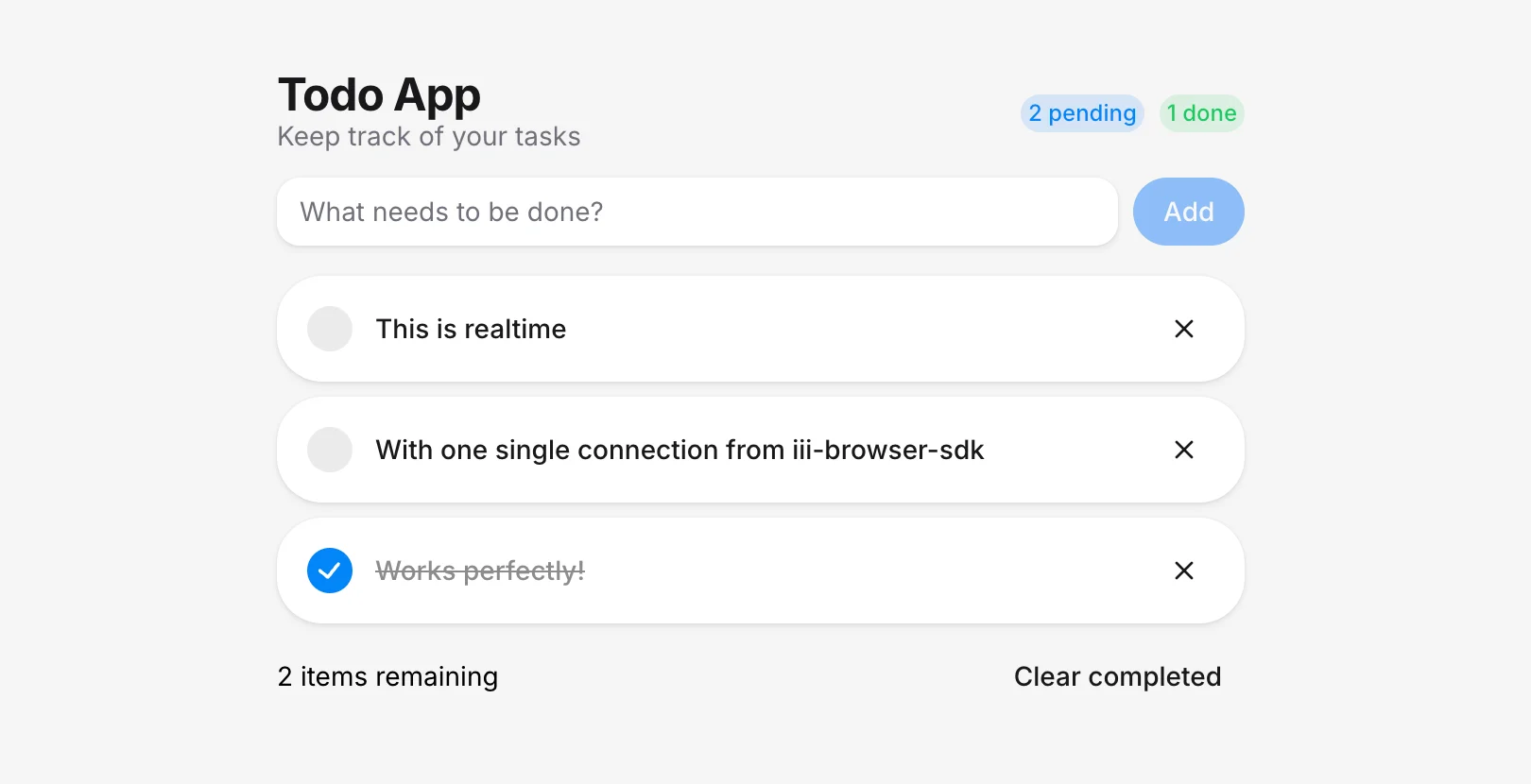 This example builds a full-stack todo app where the browser connects to the iii engine over a **single WebSocket**. That one connection handles function invocations (create, toggle, delete, list) and delivers real-time stream change events back to the UI — no polling, no separate event channel.
```mermaid theme={"theme":{"light":"catppuccin-latte","dark":"dark-plus"}}
graph LR
Browser["Browser (iii-browser-sdk)"] -->|"single WebSocket"| RBAC["RBAC Port :3111"]
RBAC -->|"auth + expose"| Engine["iii Engine"]
APIWorker["API Worker (iii-sdk)"] -->|"ws :49134"| Engine
Engine -->|"stream ops"| Stream["iii-stream :3112 (file-based KvStore)"]
Engine -->|"stream change events"| Browser
```
## Engine configuration
The `iii-config.yaml` defines the engine workers:
```yaml title="iii-config.yaml" theme={"theme":{"light":"catppuccin-latte","dark":"dark-plus"}}
workers:
- name: iii-worker-manager
config:
port: 49134
- name: iii-worker-manager
config:
host: 0.0.0.0
port: 3111
rbac:
auth_function_id: todo-project::auth-function
expose_functions:
- match("todos::create")
- match("todos::list")
- match("todos::get")
- match("todos::delete")
- match("todos::toggle")
- name: iii-exec
config:
exec:
- pnpm dev
- name: iii-stream
config:
port: 3112
host: 0.0.0.0
adapter:
name: kv
config:
store_method: file_based
file_path: ./data/stream_store
```
| Worker | Port | Purpose |
| ----------------------------- | ----- | ------------------------------------------------------------------------------------------------------------------------------------------------------------ |
| **iii-worker-manager** | 49134 | Internal port. The API worker connects here to register functions. |
| **iii-worker-manager (RBAC)** | 3111 | Public-facing port. The browser connects here. RBAC controls which functions are exposed and runs an auth function on every new connection. |
| **iii-exec** | — | Runs `pnpm dev` to start the API worker process. |
| **iii-stream** | 3112 | Manages stream state with a file-based KvStore adapter. The engine routes `stream::get`, `stream::set`, `stream::delete`, and `stream::list` to this worker. |
The RBAC configuration on port `3111` references `todo-project::auth-function` and explicitly lists the five functions the browser is allowed to call. See [Worker RBAC](../how-to/worker-rbac) for the full reference.
## Backend
### Worker setup
The API worker connects to the engine's internal port and exports a shared logger:
```typescript title="src/iii.ts" theme={"theme":{"light":"catppuccin-latte","dark":"dark-plus"}}
import { Logger, registerWorker } from 'iii-sdk'
export const iii = registerWorker(process.env.III_URL ?? 'ws://localhost:49134', {
workerName: 'api-worker',
})
export const logger = new Logger()
```
### Auth function (RBAC)
The auth function runs on every new WebSocket connection to the RBAC port. It creates a session ID and uses `function_registration_prefix` so each browser session gets its own namespace — the engine automatically prefixes function IDs registered by that session, preventing collisions.
```typescript title="src/lib/rbac.ts" theme={"theme":{"light":"catppuccin-latte","dark":"dark-plus"}}
import type { AuthInput, AuthResult } from 'iii-sdk'
import { logger } from '../iii.ts'
import { fn } from './decorators.ts'
fn('todo-project::auth-function', async (input: AuthInput): Promise => {
const sessionId = crypto.randomUUID()
logger.info('New session created', { sessionId, ip: input.ip_address })
return {
allowed_functions: [],
forbidden_functions: [],
allow_trigger_type_registration: false,
allow_function_registration: true,
allowed_trigger_types: ['stream'],
context: { session_id: sessionId },
function_registration_prefix: sessionId,
}
})
```
### Stream wrapper
The `TodoStream` class provides a typed interface over the engine's built-in stream operations. Each method triggers the corresponding `stream::*` function:
```typescript title="src/routes/todos.stream.ts" theme={"theme":{"light":"catppuccin-latte","dark":"dark-plus"}}
import type {
DeleteResult, IStream, StreamDeleteInput, StreamGetInput,
StreamListGroupsInput, StreamListInput, StreamSetInput,
StreamSetResult, StreamUpdateInput, StreamUpdateResult,
} from 'iii-sdk/stream'
import { iii } from '../iii.ts'
export interface Todo {
id: string
title: string
completed: boolean
}
const mutateArgs = (args: any) => ({ ...args, stream_name: 'todo' })
export class TodoStream implements IStream {
async get(args: Omit): Promise {
return iii.trigger({ function_id: 'stream::get', payload: mutateArgs(args) })
}
async set(args: Omit): Promise> {
return iii.trigger({ function_id: 'stream::set', payload: mutateArgs(args) })
}
async list(args: Omit): Promise {
return iii.trigger({ function_id: 'stream::list', payload: mutateArgs(args) })
}
async update(args: Omit): Promise | null> {
return iii.trigger({ function_id: 'stream::update', payload: mutateArgs(args) })
}
async delete(args: Omit): Promise {
return iii.trigger({ function_id: 'stream::delete', payload: mutateArgs(args) })
}
}
export const todosStream = new TodoStream()
```
### Functions
All functions are registered with `fn()`, a thin wrapper around `iii.registerFunction`. There are no HTTP routes — the browser calls these functions directly over the WebSocket connection.
```typescript title="src/routes/todos.create.ts" theme={"theme":{"light":"catppuccin-latte","dark":"dark-plus"}}
import { fn } from '../lib/decorators.ts'
import { type Todo, todosStream } from './todos.stream.ts'
export const createTodo = fn(
'todos::create',
async (req: { title: string }): Promise => {
const id = crypto.randomUUID()
const result = await todosStream.set({
group_id: 'todos',
item_id: id,
data: { id, title: req.title, completed: false },
})
return result.new_value
},
{ description: 'Create a new todo' },
)
```
```typescript title="src/routes/todos.list.ts" theme={"theme":{"light":"catppuccin-latte","dark":"dark-plus"}}
import { logger } from '../iii.ts'
import { fn } from '../lib/decorators.ts'
import { type Todo, todosStream } from './todos.stream.ts'
export const listTodos = fn(
'todos::list',
async (): Promise<{ items: Todo[] }> => {
logger.info('Listing todos')
const items = await todosStream.list({ group_id: 'todos' })
return { items }
},
{ description: 'List all todos' },
)
```
```typescript title="src/routes/todos.get.ts" theme={"theme":{"light":"catppuccin-latte","dark":"dark-plus"}}
import { logger } from '../iii.ts'
import { fn } from '../lib/decorators.ts'
import { type Todo, todosStream } from './todos.stream.ts'
export const getTodo = fn(
'todos::get',
async (req: { id: string }): Promise => {
logger.info('Getting todo', { id: req.id })
const item = await todosStream.get({ group_id: 'todos', item_id: req.id })
return item ?? null
},
{ description: 'Get a single TODO by ID' },
)
```
```typescript title="src/routes/todos.toggle.ts" theme={"theme":{"light":"catppuccin-latte","dark":"dark-plus"}}
import { logger } from '../iii.ts'
import { fn } from '../lib/decorators.ts'
import { type Todo, todosStream } from './todos.stream.ts'
export const toggleTodo = fn(
'todos::toggle',
async (req: { id: string }): Promise => {
logger.info('Toggling todo', { id: req.id })
const item = await todosStream.get({ group_id: 'todos', item_id: req.id })
if (!item) {
logger.warn('Todo not found', { id: req.id })
return null
}
const result = await todosStream.update({
group_id: 'todos',
item_id: req.id,
ops: [{ type: 'set', path: 'completed', value: !item.completed }],
})
return result?.new_value ?? null
},
{ description: 'Toggle a todo completed status' },
)
```
```typescript title="src/routes/todos.delete.ts" theme={"theme":{"light":"catppuccin-latte","dark":"dark-plus"}}
import { logger } from '../iii.ts'
import { fn } from '../lib/decorators.ts'
import { todosStream } from './todos.stream.ts'
export const deleteTodo = fn(
'todos::delete',
async (req: { id: string }): Promise<{ id: string; deleted: boolean }> => {
logger.info('Deleting todo', { id: req.id })
const result = await todosStream.delete({ group_id: 'todos', item_id: req.id })
return { id: req.id, deleted: result.old_value !== null }
},
{ description: 'Delete a TODO by ID' },
)
```
## Frontend
### Connection
The browser connects to the RBAC port using `iii-browser-sdk`. This single connection is used for both triggering functions and receiving real-time stream updates:
```typescript title="src/lib/iii.ts" theme={"theme":{"light":"catppuccin-latte","dark":"dark-plus"}}
import { registerWorker } from 'iii-browser-sdk'
export const iii = registerWorker('ws://localhost:3111')
```
### Real-time hook
The `useTodos` hook manages the full lifecycle — initial fetch, live updates, and CRUD operations — all through the same WebSocket connection:
```typescript title="src/hooks/use-todos.ts" theme={"theme":{"light":"catppuccin-latte","dark":"dark-plus"}}
import type { StreamChangeEvent } from 'iii-browser-sdk/stream'
import { useCallback, useEffect, useMemo, useState } from 'react'
import { iii } from '../lib/iii'
export interface Todo {
id: string
title: string
completed: boolean
}
export function useTodos() {
const [todos, setTodos] = useState([])
useEffect(() => {
void iii
.trigger, { items: Todo[] }>({
function_id: 'todos::list',
payload: {},
})
.then(({ items }) => setTodos(items))
const funcRef = iii.registerFunction(
'ui::on-todo-change',
async (input: StreamChangeEvent) => {
const todo = input.event.data as Todo
switch (input.event.type) {
case 'create':
setTodos((prev) => [...prev, todo])
break
case 'update':
setTodos((prev) => prev.map((t) => (t.id === input.id ? todo : t)))
break
case 'delete':
setTodos((prev) => prev.filter((t) => t.id !== input.id))
break
}
return {}
},
)
const trigger = iii.registerTrigger({
type: 'stream',
function_id: funcRef.id,
config: { stream_name: 'todo', group_id: 'todos' },
})
return () => {
trigger.unregister()
funcRef.unregister()
}
}, [])
const addTodo = useCallback(async (title: string) => {
await iii.trigger({ function_id: 'todos::create', payload: { title } })
}, [])
const toggleTodo = useCallback(async (id: string) => {
await iii.trigger({ function_id: 'todos::toggle', payload: { id } })
}, [])
const deleteTodo = useCallback(async (id: string) => {
await iii.trigger({ function_id: 'todos::delete', payload: { id } })
}, [])
const clearCompleted = useCallback(async () => {
const completed = todos.filter((t) => t.completed)
await Promise.all(
completed.map(({ id }) =>
iii.trigger({ function_id: 'todos::delete', payload: { id } }),
),
)
}, [todos])
const remaining = useMemo(() => todos.filter((t) => !t.completed).length, [todos])
const completedCount = useMemo(() => todos.filter((t) => t.completed).length, [todos])
return { todos, addTodo, toggleTodo, deleteTodo, clearCompleted, remaining, completedCount }
}
```
The hook does three things on mount:
1. **Fetches** the current list by triggering `todos::list`.
2. **Subscribes** to real-time changes by registering a local function (`ui::on-todo-change`) and binding it to a `stream` trigger on the `todo` stream. The engine pushes `StreamChangeEvent` payloads (create, update, delete) whenever the stream changes.
3. **Cleans up** by unregistering both the function and the trigger on unmount.
All CRUD operations (`addTodo`, `toggleTodo`, `deleteTodo`) call `iii.trigger` with the corresponding function ID. The response arrives over the same connection, and the stream trigger delivers the update to all connected clients.
## Key concepts
* **Single connection** — The browser opens one WebSocket to the RBAC port. Function calls and real-time stream events flow over the same connection.
* **No HTTP routes** — The API worker registers plain iii functions. The browser invokes them directly via `iii.trigger`. There is no REST layer.
* **RBAC** — The engine's iii-worker-manager supports auth functions, expose lists, and middleware. This example uses a simple auth function that creates a session. See [Worker RBAC](../how-to/worker-rbac) for the full reference.
* **Engine-managed streams** — The `iii-stream` worker handles persistence (file-based KvStore in this example). The API worker reads and writes through `stream::*` function triggers — no custom stream implementation required.
* **Session isolation** — The auth function returns a `function_registration_prefix`. The engine prefixes every function registered by that browser session, so multiple clients can register `ui::on-todo-change` without colliding.
This example builds a full-stack todo app where the browser connects to the iii engine over a **single WebSocket**. That one connection handles function invocations (create, toggle, delete, list) and delivers real-time stream change events back to the UI — no polling, no separate event channel.
```mermaid theme={"theme":{"light":"catppuccin-latte","dark":"dark-plus"}}
graph LR
Browser["Browser (iii-browser-sdk)"] -->|"single WebSocket"| RBAC["RBAC Port :3111"]
RBAC -->|"auth + expose"| Engine["iii Engine"]
APIWorker["API Worker (iii-sdk)"] -->|"ws :49134"| Engine
Engine -->|"stream ops"| Stream["iii-stream :3112 (file-based KvStore)"]
Engine -->|"stream change events"| Browser
```
## Engine configuration
The `iii-config.yaml` defines the engine workers:
```yaml title="iii-config.yaml" theme={"theme":{"light":"catppuccin-latte","dark":"dark-plus"}}
workers:
- name: iii-worker-manager
config:
port: 49134
- name: iii-worker-manager
config:
host: 0.0.0.0
port: 3111
rbac:
auth_function_id: todo-project::auth-function
expose_functions:
- match("todos::create")
- match("todos::list")
- match("todos::get")
- match("todos::delete")
- match("todos::toggle")
- name: iii-exec
config:
exec:
- pnpm dev
- name: iii-stream
config:
port: 3112
host: 0.0.0.0
adapter:
name: kv
config:
store_method: file_based
file_path: ./data/stream_store
```
| Worker | Port | Purpose |
| ----------------------------- | ----- | ------------------------------------------------------------------------------------------------------------------------------------------------------------ |
| **iii-worker-manager** | 49134 | Internal port. The API worker connects here to register functions. |
| **iii-worker-manager (RBAC)** | 3111 | Public-facing port. The browser connects here. RBAC controls which functions are exposed and runs an auth function on every new connection. |
| **iii-exec** | — | Runs `pnpm dev` to start the API worker process. |
| **iii-stream** | 3112 | Manages stream state with a file-based KvStore adapter. The engine routes `stream::get`, `stream::set`, `stream::delete`, and `stream::list` to this worker. |
The RBAC configuration on port `3111` references `todo-project::auth-function` and explicitly lists the five functions the browser is allowed to call. See [Worker RBAC](../how-to/worker-rbac) for the full reference.
## Backend
### Worker setup
The API worker connects to the engine's internal port and exports a shared logger:
```typescript title="src/iii.ts" theme={"theme":{"light":"catppuccin-latte","dark":"dark-plus"}}
import { Logger, registerWorker } from 'iii-sdk'
export const iii = registerWorker(process.env.III_URL ?? 'ws://localhost:49134', {
workerName: 'api-worker',
})
export const logger = new Logger()
```
### Auth function (RBAC)
The auth function runs on every new WebSocket connection to the RBAC port. It creates a session ID and uses `function_registration_prefix` so each browser session gets its own namespace — the engine automatically prefixes function IDs registered by that session, preventing collisions.
```typescript title="src/lib/rbac.ts" theme={"theme":{"light":"catppuccin-latte","dark":"dark-plus"}}
import type { AuthInput, AuthResult } from 'iii-sdk'
import { logger } from '../iii.ts'
import { fn } from './decorators.ts'
fn('todo-project::auth-function', async (input: AuthInput): Promise => {
const sessionId = crypto.randomUUID()
logger.info('New session created', { sessionId, ip: input.ip_address })
return {
allowed_functions: [],
forbidden_functions: [],
allow_trigger_type_registration: false,
allow_function_registration: true,
allowed_trigger_types: ['stream'],
context: { session_id: sessionId },
function_registration_prefix: sessionId,
}
})
```
### Stream wrapper
The `TodoStream` class provides a typed interface over the engine's built-in stream operations. Each method triggers the corresponding `stream::*` function:
```typescript title="src/routes/todos.stream.ts" theme={"theme":{"light":"catppuccin-latte","dark":"dark-plus"}}
import type {
DeleteResult, IStream, StreamDeleteInput, StreamGetInput,
StreamListGroupsInput, StreamListInput, StreamSetInput,
StreamSetResult, StreamUpdateInput, StreamUpdateResult,
} from 'iii-sdk/stream'
import { iii } from '../iii.ts'
export interface Todo {
id: string
title: string
completed: boolean
}
const mutateArgs = (args: any) => ({ ...args, stream_name: 'todo' })
export class TodoStream implements IStream {
async get(args: Omit): Promise {
return iii.trigger({ function_id: 'stream::get', payload: mutateArgs(args) })
}
async set(args: Omit): Promise> {
return iii.trigger({ function_id: 'stream::set', payload: mutateArgs(args) })
}
async list(args: Omit): Promise {
return iii.trigger({ function_id: 'stream::list', payload: mutateArgs(args) })
}
async update(args: Omit): Promise | null> {
return iii.trigger({ function_id: 'stream::update', payload: mutateArgs(args) })
}
async delete(args: Omit): Promise {
return iii.trigger({ function_id: 'stream::delete', payload: mutateArgs(args) })
}
}
export const todosStream = new TodoStream()
```
### Functions
All functions are registered with `fn()`, a thin wrapper around `iii.registerFunction`. There are no HTTP routes — the browser calls these functions directly over the WebSocket connection.
```typescript title="src/routes/todos.create.ts" theme={"theme":{"light":"catppuccin-latte","dark":"dark-plus"}}
import { fn } from '../lib/decorators.ts'
import { type Todo, todosStream } from './todos.stream.ts'
export const createTodo = fn(
'todos::create',
async (req: { title: string }): Promise => {
const id = crypto.randomUUID()
const result = await todosStream.set({
group_id: 'todos',
item_id: id,
data: { id, title: req.title, completed: false },
})
return result.new_value
},
{ description: 'Create a new todo' },
)
```
```typescript title="src/routes/todos.list.ts" theme={"theme":{"light":"catppuccin-latte","dark":"dark-plus"}}
import { logger } from '../iii.ts'
import { fn } from '../lib/decorators.ts'
import { type Todo, todosStream } from './todos.stream.ts'
export const listTodos = fn(
'todos::list',
async (): Promise<{ items: Todo[] }> => {
logger.info('Listing todos')
const items = await todosStream.list({ group_id: 'todos' })
return { items }
},
{ description: 'List all todos' },
)
```
```typescript title="src/routes/todos.get.ts" theme={"theme":{"light":"catppuccin-latte","dark":"dark-plus"}}
import { logger } from '../iii.ts'
import { fn } from '../lib/decorators.ts'
import { type Todo, todosStream } from './todos.stream.ts'
export const getTodo = fn(
'todos::get',
async (req: { id: string }): Promise => {
logger.info('Getting todo', { id: req.id })
const item = await todosStream.get({ group_id: 'todos', item_id: req.id })
return item ?? null
},
{ description: 'Get a single TODO by ID' },
)
```
```typescript title="src/routes/todos.toggle.ts" theme={"theme":{"light":"catppuccin-latte","dark":"dark-plus"}}
import { logger } from '../iii.ts'
import { fn } from '../lib/decorators.ts'
import { type Todo, todosStream } from './todos.stream.ts'
export const toggleTodo = fn(
'todos::toggle',
async (req: { id: string }): Promise => {
logger.info('Toggling todo', { id: req.id })
const item = await todosStream.get({ group_id: 'todos', item_id: req.id })
if (!item) {
logger.warn('Todo not found', { id: req.id })
return null
}
const result = await todosStream.update({
group_id: 'todos',
item_id: req.id,
ops: [{ type: 'set', path: 'completed', value: !item.completed }],
})
return result?.new_value ?? null
},
{ description: 'Toggle a todo completed status' },
)
```
```typescript title="src/routes/todos.delete.ts" theme={"theme":{"light":"catppuccin-latte","dark":"dark-plus"}}
import { logger } from '../iii.ts'
import { fn } from '../lib/decorators.ts'
import { todosStream } from './todos.stream.ts'
export const deleteTodo = fn(
'todos::delete',
async (req: { id: string }): Promise<{ id: string; deleted: boolean }> => {
logger.info('Deleting todo', { id: req.id })
const result = await todosStream.delete({ group_id: 'todos', item_id: req.id })
return { id: req.id, deleted: result.old_value !== null }
},
{ description: 'Delete a TODO by ID' },
)
```
## Frontend
### Connection
The browser connects to the RBAC port using `iii-browser-sdk`. This single connection is used for both triggering functions and receiving real-time stream updates:
```typescript title="src/lib/iii.ts" theme={"theme":{"light":"catppuccin-latte","dark":"dark-plus"}}
import { registerWorker } from 'iii-browser-sdk'
export const iii = registerWorker('ws://localhost:3111')
```
### Real-time hook
The `useTodos` hook manages the full lifecycle — initial fetch, live updates, and CRUD operations — all through the same WebSocket connection:
```typescript title="src/hooks/use-todos.ts" theme={"theme":{"light":"catppuccin-latte","dark":"dark-plus"}}
import type { StreamChangeEvent } from 'iii-browser-sdk/stream'
import { useCallback, useEffect, useMemo, useState } from 'react'
import { iii } from '../lib/iii'
export interface Todo {
id: string
title: string
completed: boolean
}
export function useTodos() {
const [todos, setTodos] = useState([])
useEffect(() => {
void iii
.trigger, { items: Todo[] }>({
function_id: 'todos::list',
payload: {},
})
.then(({ items }) => setTodos(items))
const funcRef = iii.registerFunction(
'ui::on-todo-change',
async (input: StreamChangeEvent) => {
const todo = input.event.data as Todo
switch (input.event.type) {
case 'create':
setTodos((prev) => [...prev, todo])
break
case 'update':
setTodos((prev) => prev.map((t) => (t.id === input.id ? todo : t)))
break
case 'delete':
setTodos((prev) => prev.filter((t) => t.id !== input.id))
break
}
return {}
},
)
const trigger = iii.registerTrigger({
type: 'stream',
function_id: funcRef.id,
config: { stream_name: 'todo', group_id: 'todos' },
})
return () => {
trigger.unregister()
funcRef.unregister()
}
}, [])
const addTodo = useCallback(async (title: string) => {
await iii.trigger({ function_id: 'todos::create', payload: { title } })
}, [])
const toggleTodo = useCallback(async (id: string) => {
await iii.trigger({ function_id: 'todos::toggle', payload: { id } })
}, [])
const deleteTodo = useCallback(async (id: string) => {
await iii.trigger({ function_id: 'todos::delete', payload: { id } })
}, [])
const clearCompleted = useCallback(async () => {
const completed = todos.filter((t) => t.completed)
await Promise.all(
completed.map(({ id }) =>
iii.trigger({ function_id: 'todos::delete', payload: { id } }),
),
)
}, [todos])
const remaining = useMemo(() => todos.filter((t) => !t.completed).length, [todos])
const completedCount = useMemo(() => todos.filter((t) => t.completed).length, [todos])
return { todos, addTodo, toggleTodo, deleteTodo, clearCompleted, remaining, completedCount }
}
```
The hook does three things on mount:
1. **Fetches** the current list by triggering `todos::list`.
2. **Subscribes** to real-time changes by registering a local function (`ui::on-todo-change`) and binding it to a `stream` trigger on the `todo` stream. The engine pushes `StreamChangeEvent` payloads (create, update, delete) whenever the stream changes.
3. **Cleans up** by unregistering both the function and the trigger on unmount.
All CRUD operations (`addTodo`, `toggleTodo`, `deleteTodo`) call `iii.trigger` with the corresponding function ID. The response arrives over the same connection, and the stream trigger delivers the update to all connected clients.
## Key concepts
* **Single connection** — The browser opens one WebSocket to the RBAC port. Function calls and real-time stream events flow over the same connection.
* **No HTTP routes** — The API worker registers plain iii functions. The browser invokes them directly via `iii.trigger`. There is no REST layer.
* **RBAC** — The engine's iii-worker-manager supports auth functions, expose lists, and middleware. This example uses a simple auth function that creates a session. See [Worker RBAC](../how-to/worker-rbac) for the full reference.
* **Engine-managed streams** — The `iii-stream` worker handles persistence (file-based KvStore in this example). The API worker reads and writes through `stream::*` function triggers — no custom stream implementation required.
* **Session isolation** — The auth function returns a `function_registration_prefix`. The engine prefixes every function registered by that browser session, so multiple clients can register `ui::on-todo-change` without colliding.