harness
v1.9.14Thin durable turn loop that wires session-manager, context-manager, and llm-router into an agent loop; spawns sub-agents as child sessions.
Install
iii trigger compose::add worker=harnessRun in your project with the iii engine running. Exact versions are immutable and digest-pinned.
harness
A thin, durable turn loop that turns a model plus a few iii workers into an agent.





harness is the thin, durable turn loop that turns a model plus a few iii
workers into an agent. It takes an incoming message, persists it, assembles a
context, streams a completion, runs any function calls the model requests, and
repeats until the turn stops — all as durable, resumable steps so a crash or
restart picks up mid-turn. It wires session-manager
(transcript), context-manager (token budgeting, soft
dependency), and llm-router (generation); install those
alongside it for the full loop.
Quickstart
Install the engine, export the Anthropic credential in the terminal that will run the engine, initialize a project, and start it:
curl -fsSL https://install.iii.dev/iii/main/install.sh | sh
export ANTHROPIC_API_KEY='<your-anthropic-api-key>'
export OPENAI_API_KEY='<your-openai-api-key>'
iii project init iii-app && cd iii-app
iii compose --up
# New terminal, same folder. `compose::add` updates this Compose project.
cd iii-app
iii call compose::add worker=harness worker=adeopen http://localhost:3113Create a session, select Anthropic → Claude Sonnet 5, and send your first
message. Then select OpenAI → GPT-5.6 Luna in the same chat and send another
message. Create a new chat and send one more message with GPT-5.6 Luna. The
providers read ANTHROPIC_API_KEY and OPENAI_API_KEY from the engine
environment, so credentials do not need to be pasted into or stored by the
Console.
iii call compose::add worker=harness installs every worker the loop needs (see the badges
above); you do not add them one by one. During bootstrap, the harness asks the
queue worker to define a dedicated harness-turn queue before it reports
ready. That queue is FIFO within each session_id and processes separate
sessions concurrently; startup fails if the queue cannot be ensured.
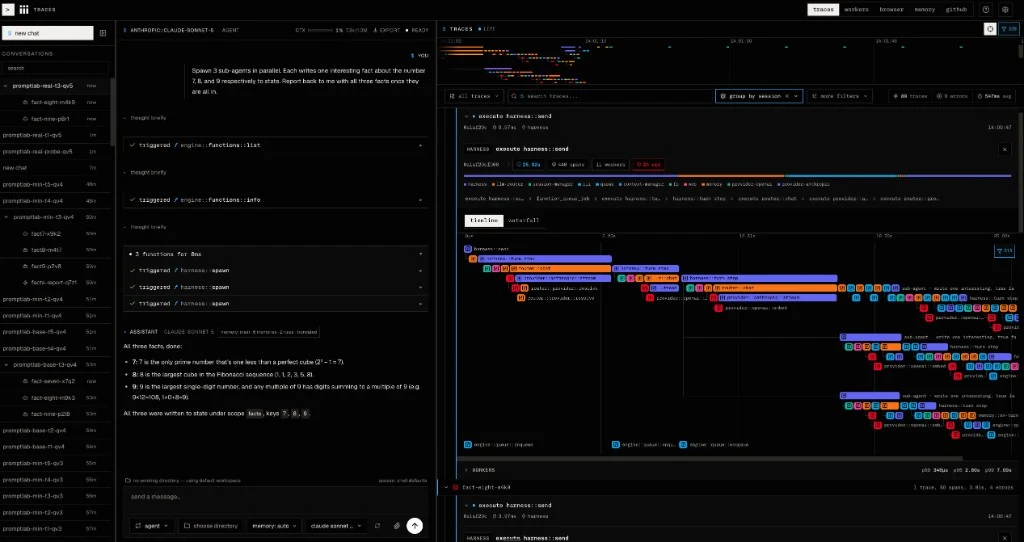
Every turn, sub-agent spawn, and provider call is one correlated trace: the harness turn waterfall in the console. Failed descendants stamp the whole trace as failed and carry standard error attributes. The session transcript keeps the same recovery, partial-output, and blocked-reaction explanation after refresh. Automatic generation recovery requires partial output from the failed response. A startup failure with no output ends the turn with a durable failure notice; it does not consume the partial-response recovery budget.
The agent-facing function surface is deny-by-default: with no functions.allow
globs, every model-requested call is refused and the harness is a plain chat
loop. Allow functions in per-send (options.functions.allow) and gate them
with the optional approval-gate sibling.
A sandbox operation answers as the router's sandbox::<op> and as the adapter's own
<adapter>::<op> (sandbox-libkrun, or the adapter sandbox::adapter::info reports). A
functions.deny glob or a hook's functions glob matching either id covers both;
functions.allow stays literal. sandbox-libkrun is always covered, a custom adapter's prefix
once a read of sandbox::adapter::info succeeds, at startup and on each registry change. If it
fails, for example because RBAC refuses it, the harness logs a warning and the adapter's ids stay
callable until a later read succeeds.
Before dispatch, arguments that fail the target's schema are reconciled: stringified JSON the
schema rejects is parsed. When the optional
judge worker is deployed, it also settles
misnamed keys, off-enum values and unknown arguments; it sees the arguments with secret-keyed
values (password, token, api_key, authorization, …) masked and long strings cut. Every
repair is noted in the call's result.
The full function reference (every harness::* id and its request/response
schema) lives in the code and iii call engine::workers::info name=harness.
Building a consumer — a chat UI, a Telegram/WhatsApp bridge, a cron worker, or
any event-driven loop on top of the harness? Start with the integration
contract in
architecture/integration.md: the functions to
call, the functions to observe, and the canonical consumer patterns.
Local development
See DEVELOPMENT.md to run the Harness and its required
workers from the local source tree with iii compose.
Working with iii
iii is a language agnostic runtime where services, agents, and tools are composed of the same things: workers, functions, and observers. One engine holds a live registry of every connected worker, their functions, and the observers of those functions. Calls route worker to engine to worker, so the language, runtime, and location of a worker are invisible; the function id is the only contract.
1. Discover what is already there (the engine is the source of truth)
engine::functions::list— every function across all workers (filter withprefix/search/worker)engine::functions::info { function_id }— the request/response schema for ONE function (this is your API reference)engine::workers::list/engine::workers::info { name }— connected workers and their surfaceengine::functions::info { function_id }also gives a function'sargs_format— the args its observers passengine::observers::list— every observer that exists
2. Call a function. Use agent_call with { function: "<worker>::<fn>", description: "<short user-facing action>", payload: { ... } }. The description is shown as the agent's activity in chat; keep it concise and in the session's response language (named in the runtime context, detected from the user's first message). The payload is a JSON object (never a stringified one), and you fetch the contract via engine::functions::info before the first call.
3. Need a capability that is not registered?
directory::registry::workers::list { search: "<capability>" }directory::registry::workers::info { name }to judge fit- choose an operation id and observe
compose::on-operation-progresswith a one-shot wake filtered on{ "input.operation_id": { "$eq": "<operation-id>" }, "input.terminal": { "$eq": true } } - call
compose::add { worker: "<name>", operation_id: "<operation-id>" }with the same id - read
compose::operationonce for race recovery, then confirm the functions after the terminal event
4. Worker lifecycle. compose::status, compose::add, compose::up, compose::down, compose::restart, compose::update, and compose::remove. add, update, and remove use the same Compose operation wake flow above; the other operations return their final result directly. add, update, and remove accept a workers list for one batch, while their singular worker field remains compatible. Fetch their contracts with compose::schema { function_id: "compose::<operation>" }. The harness routes compose::* to its supervising daemon and scopes each call to its own compose file.
5. Observers, not polling. To react to events (HTTP, schedule, webhook, file change), observe the function that emits them: harness::observe from a turn, iii.observe from a worker. Find the function with engine::functions::list, copy its args and filter fields from engine::functions::info, and confirm the observer delivers with a real call (e.g. web::fetch to its local URL).
6. Handy workers.
web::fetch— all HTTP(S); passformat: "markdown"to read docs without flooding contextcoder::*— file ops for any code task (read/search/create/update/move/delete)slack::*— post to Slack
7. Authoring a worker. Read the SDK reference for your language first (Node / Python / Rust / Browser / Engine WS) at https://iii.dev/docs/reference/. Use the SDK's registerWorker(...) and call iii.registerFunction / iii.observe / iii.call on the returned value; they are methods, not top-level exports. Always declare description, request_format, and response_format so the next caller gets a real contract.
TL;DR: list, info, call. The engine tells you the truth; trust it over memory.
Adding workers with container settings
Fetch compose::schema { function_id: "compose::add" } before choosing the payload.
Use container objects only if the running daemon's schema supports them. The singular
worker field remains a string shorthand. For settings, use workers, which can mix
strings and objects. Put settings inside each object, not at the request's top level.
Only add accepts objects; update and remove take worker names.
After registering the one-shot wake described above, call compose::add with a payload
like this (the local worker directory and env file must already exist):
{
  "operation_id": "<operation-id>",
  "workers": [
    "state",
    {
      "worker": "./workers/api",
      "start_after": ["state"],
      "scripts": {
        "pre_run": "pnpm build",
        "pre_run_timeout": "60s",
        "run": "pnpm start",
        "post_run": "echo stopped"
      },
      "config_name": "api",
      "config_override": { "port": 3000 },
      "working_dir": "./workers/api",
      "environment": { "NODE_ENV": "development" },
      "env_file": ["./api.env"],
      "startup_timeout": "30s"
    }
  ]
}
worker accepts a package name, name@version, registry reference, or local directory,
including package:// and path:// sources. Objects also accept version for packages;
it must agree with any version in worker. Omission resolves the latest matching package
version, so keep an explicit version when it must stay pinned.
Use scripts (plural); scripts.run is valid only for local workers. start_after
contains container keys, derived from the last part of each worker name or directory;
required package dependencies are also included. config_name selects the base configuration,
and config_override supplies values over it. environment values must be strings.
startup_timeout limits the wait for registration.
Relative worker, working_dir, and env_file paths start at the compose file's directory.
working_dir sets the process and hook directory; when omitted, local workers use their own
directory and packages use the compose directory.
For an existing container, omitted settings stay in place. A supplied field replaces that
whole field, including scripts, environment, and config_override; these are not
partial map edits. Use {} or [] to clear maps or lists. A supplied start_after replaces
the list while retaining required package dependencies. Changes can restart running workers.
The acceptance response does not mean ready: finish the same Compose operation wake flow
before using the worker.
Configuration
The harness configuration entry is owned by the configuration worker; every
field hot-reloads (no restart). The fields a deployment is most likely to tune:
default_max_turns: 16            # per-turn generate-step cap when a send omits it
default_pending_timeout_ms: 1800000  # legacy parked-call (hold / pre-deploy child) wait guard
max_depth: 3                     # sub-agent depth budget
max_children: 8                  # sub-agent spawns-per-turn budget
max_transient_resumes: 3         # recovery generations per turn after retryable provider failures; a turn that still fails reports failure.retryable: true on harness::status
max_result_bytes: 262144         # function-result byte cap at capture; oversized results become an elision marker (0 = off)
prompt_cache_sections: true      # send the frozen profile prefix as its own cacheable section (+ digest) on router::chat
co_author: true                  # tell agents to end git commit messages with "Co-authored-by: iii harness (<model>) <noreply@iii.dev>"
call_reconciliation: judge       # repair malformed call arguments before dispatch: off | coerce (lossless parses) | judge (+ judge::evaluate when deployed)
projects_file_path: ~/.iii/data/harness/projects.json  # durable operator project catalog (default: data/harness-projects.json under III_COMPOSE_DIR / cwd)
sweep_expression: "0 * * * * *"  # cron for the pending-call expiry sweep
Other keys (RPC timeouts, stream coalescing, idempotency TTL, validation
retries) and their defaults live in src/config.rs.
Anonymous usage reporting
The harness announces its own usage on the durable harness:usage topic. The
engine subscribes to that topic and sends one anonymous product event for each
message. Three moments report:
harness_user_turns, when the user turns (root turns: one user message through its final reply) counted across every session in the state store reach 1, 2, 5, 10, 25 and 50, then every 50 after that (100, 150, ...). It carriesuser_turns_total,sessions_total, andby_model: user turns per provider and model of the root turn, and sessions per provider and model of the session's first root turn.harness_model_calls, on the same milestones of the model calls (assistant messages, sub-agents included) counted across every session in the state store. Model calls move several at a time, so a report goes out at the highest milestone passed. It carriesmodel_calls_total, tool call and tool call error totals, token totals,cost_usd,user_turns_total,sessions_totalandsubagents_total, all across the state store, andby_model: model calls, tool calls, tokens and cost per provider and model that generated them.subagents_totalcounts each sub-agent session one time, when it is first seen in its root's session tree.subagent_max_depthis the deepest sub-agent level that any session tree reached. It has no*_delta.
Every counter on both events, in total and in each by_model entry, has a
matching *_delta (for example tool_calls_delta, cost_usd_delta): the
count since the previous report of the same event. The deltas of one state
store sum to its totals, so they can be added up across stores and time
windows.
harness_turn_failed, once per session for each of thefailed,cancelledandmax_turnsoutcomes. This keeps the reason a run stopped exact.
harness_turn_failed carries the failed turn's model and provider; the two
counting events carry them only inside by_model, because their totals span
every model. Beyond those and the counters above, a message carries only a
fixed failure class: no message text, no prompt, no file path and no function
id. Sub-agent turns report nothing of their own; their model calls are
counted through their root session when its turn ends.
- A spawn with only a display parent (
parent_session_id) is not a root turn. Its model calls are counted at the display parent's next root turn. If the parent has no further turn, they are not counted. - A spawn with no parent is a root session, so its turn counts as a user turn.
- A failed turn counts as a user turn. Its
harness_turn_failedevent carrieserror_kind;llm.unknown_modelmeans the model is not in the router catalog, andllm.unknownmeans the failure has no classification. - A session that an earlier harness release ran takes its usage so far as a baseline on its first turn after the upgrade. That usage is not counted again.
- A fork (
session::fork) takes the history it copied as its baseline, so only the model calls the fork makes are counted. - The usage already counted is kept per session of the tree. When a session is deleted from the tree, the model calls of the other sessions are still counted.
The reporting keeps its own bookkeeping and only reads the harness's
accounting (harness::metrics). The counters live in the state worker's
store, so each project counts on its own with the default file-backed state
(and an in_memory store starts again from zero). The harness_usage/_machine
row holds the store-wide counters, updated by compare-and-set. Each
harness_usage/<session_id> row records the outcomes a session announced and
the model usage already folded in, per session of its tree, so a turn after a
restart does not count that usage again. A crash after the _machine update
and before the session row is saved folds that turn's model usage twice. Each
step is best effort: a failed read or publish is logged at debug level and the
turn continues.
To stop the reports, set III_TELEMETRY_ENABLED=false on the engine. The engine
then takes the messages from the topic and discards them, so an opted-out
deployment stores nothing.
System prompt
The identity prompt is assembled once at send/spawn time. EVERY agent —
top-level turns (harness::send) and spawned children alike — is seeded with
the same single identity
(prompts/default.txt): a deliberately minimal prompt
carrying only the basic engine functions and the discovery loop (list, info,
call). A default entry in the directory's system-prompt store
(<skills_folder>/system-prompts/default.md, served by
directory::system-prompts::get) overrides the embedded prompt for every new
composition — write it with directory::system-prompts::create { name: "default" } the first time and ::update after (or edit the file directly; no
console surface authors it) and the next send picks that up, no restart;
any store failure (directory absent, entry missing, blank body) falls back to
the embedded prompt. What makes a child a leaf is its POLICY, not its prompt: children are
capability-walled out of the orchestration surface (harness::spawn,
harness::send, harness::unobserve) unless spawned with
options: { orchestrator: true }; spawn options.system_prompt remains the
identity escape hatch.
A spawn may also give its child a display-only identity with
display: { name, icon?, color? }. name is trimmed, cut to its first 48
characters when longer (never refused for its length), and becomes the title of a newly created child session; icon and color are
closed semantic tokens recorded with the child linkage in
metadata.subagent_display. These fields never affect routing or execution,
and reusing an existing session_id retains that session's original title and
metadata. Icons are agent, code, search, terminal, database, test,
review, docs, or design; colors are neutral, blue, purple, teal,
green, amber, or rose.
No prompt prescribes an orchestration process — identity prompts carry tool
guidance only, enforced repo-wide by tests/prompts.rs.
The opt-in fan-out playbook (parent-owned control plane: pick a medium, arm
notifications, spawn leaves directly, define completion per medium) lives in
skills/orchestration.md — paste it into a task
prompt or pass it via options.system_prompt.
A non-empty options.system_prompt is combined with the built-in
prompt per options.system_prompt_strategy: enrich (default) appends it to
the built-in prompt, while override uses it verbatim. Assembly is tested in
src/prompt/tests.rs.
The resolved prompt is STICKY per session, like model/provider and the
dispatch policy: a send to an existing session that names neither
system_prompt nor system_prompt_strategy inherits the prior turn's
resolved prompt verbatim (a prior disabled turn's absent prompt inherits
too). Naming either field resolves fresh — an explicit bare
system_prompt_strategy (e.g. "enrich") is the reset-to-default escape
hatch. The inherited string is frozen at its original resolution — resend
the prompt fields to re-resolve.
Reasoning is sticky the same way: a send that names neither
thinking_level nor provider_options keeps the prior turn's pair, so an
omitted field never silently resets the effort (which would also bust the
provider's messages cache). Naming either field replaces the pair —
provider_options: {} resets to the provider default.
options.reasoning: "lowest" asks the harness to choose the effort instead:
the first entry other than none in the model's reasoning_efforts, else
minimal for a model that only reports supports_thinking, else no effort
(the provider decides). It cannot be combined with thinking_level or
provider_options, fails the send when the router has no catalog row for
the model, and the send response reports the choice as reasoning
(thinking_level and the native reasoning_effort). Later sends inherit it
like any explicit effort.
The prompt reaches router::chat in two forms: the flat system_prompt,
and system_sections — the STABLE prefix (the frozen profile or identity
prompt plus the frozen skills index, cache_boundary: true) followed by the
per-session tail (session id, working directory, policy aid, and whatever
context assembly and hooks append). Two sessions on the same profile send
the same stable bytes, and cache_intent.surface_digest (sha256: of that
section) names them, so cache-aware providers can keep one prefix entry for
all of them — when the provider supports it and the prefix meets its minimum
cacheable size: Anthropic puts its cache marker on the boundary block, OpenAI
and Codex derive prompt_cache_key from the digest. The digest is a local
identity, never evidence of a hit — usage.cache_read is. harness::status
reports it as context.prompt_surface_digest, or
context.prompt_sections_fallback when no sections went out: disabled
(prompt_cache_sections: false), no_stable_prefix, or prefix_rewritten
(a pre_generate hook replaced the prompt head — the hook's prompt still
wins, it just shares nothing).
Agent profiles
options.agent on a session-creating harness::send names a directory agent
profile (directory::agents::*, one markdown file per profile). The harness
resolves it ONCE via directory::agents::get and freezes the result onto the
turn: the profile's RESOLVED system prompt — the directory composes extends
chains root-first, so tech-lead extending the bundled iii base arrives as
the full iii doctrine followed by the tech-lead body — IS the session
identity. Nothing built-in sits underneath it and no prefix is added; the
usual per-step runtime context (session id, working directory, response language, policy aid,
skills index, hook injections) follows it. A profile whose extends chain does not resolve is refused as an
invalid request with the directory's D415 text. The profile's skills are
PRELOADED: each id's body is fetched once from directory::skills::get and
frozen into a <preloaded_skills> block of <skill id="…"> sections
appended to the prompt (ids the directory cannot serve are named as
unavailable), so the skill is in context on the first step; the session's
skills index is never narrowed by a profile — only an explicit
options.skills does that. A profile with skills_index: false (inherited
through extends) starts its sessions, and children running as it, with no
skills index at all; such a session ignores options.skills on its opening
send and refuses it later. Its preloaded skills still render, and
directory::skills::get stays callable when the policy allows it. Its
model and optional provider-native reasoning_effort are authoritative for
the session, and — when the send also omits
options.functions — the dispatch policy defaults to the configured
default_functions baseline instead of deny-all (an identity picked to DO
something must be able to dispatch). When the profile declares (or
inherits) functions — its PRELOADED functions, engine function ids it uses
routinely — the harness renders each one's current description and
compacted request schema into a <preloaded_functions> block appended to the
frozen prompt (contracts come from the cached registry snapshot, with one
engine::functions::info batch for ids the snapshot cannot vouch for; ids
the engine does not know are named as unavailable), so the model calls them
on the first step instead of spending a search and a contract lookup per
session. The <preloaded_functions> block comes first, <preloaded_skills>
after it. The frozen block is never rewritten (it is the shared cache
prefix); when a preloaded contract later changes, disappears, or an
unavailable one appears, every step carries a tail notice naming exactly
those ids until a new session resolves the profile afresh. The frozen name/icon/color/model/effort/skills/functions snapshot is also
written to session metadata for clients that render established sessions. The frozen identity
travels with the prompt-stickiness rule: bare later sends
inherit it, an explicit prompt field sheds it. Refused on an existing
session or combined with either prompt field. Directory edits after
resolution never reach a live session — start a new one to pick them up.
harness::spawn takes the same id as a top-level agent field: the profile's
resolved prompt (preloaded functions and skills included) is the child's whole identity, its model/effort slot in the same way
(model precedence profile → explicit model → parent, without dragging the parent's
provider onto a foreign model), and its name and icon become the display
defaults. A spawn that names NO profile continues the parent turn's: an agent
running under a profile fans work out to itself, not to a stranger wearing the
built-in identity, and the child re-resolves that same id so its own preloaded
functions and skills arrive with it. options.system_prompt — the escape hatch
for a child that genuinely needs a different identity — sheds the inherited
profile instead of colliding with it, and a parentless spawn (console,
workflow, CLI) has no parent turn to inherit from. Which agent profile a spawn
names is the prompt's decision — the profile body steers it, nothing gates it.
Spawning
with agent into an already RUNNING session of the caller's own tree merges
the task like any reuse and does not re-apply the profile.
A spawned child also starts with the contracts it would otherwise look up
first, in a <preloaded_functions> block of its own (MOT-4851). The block
holds, capped at 30 contracts:
- its whole allow-list, when that is a short (≤ 30), glob-free list of explicit ids;
- then every function id its task names verbatim (for example
`coder::read-file`).
Only ids the child may dispatch are seeded, and only when the registry lists
them. Discovery grants and ids its profile already preloads are skipped, and
expose: native seeds nothing, because the tools already carry the schemas.
The block is frozen at spawn and rides after the cache seam (the runtime aid),
so default-identity sessions keep sharing their stable prefix. Its digests join
the preloaded-contract stale notice.
The harness ships one profile of its own, worker-builder
(agents/worker-builder.md): an identity that
extends the bundled iii base and takes a new worker for this repository from
scope to scaffold, CI gates, live verification on the bus, pull request, and an
experimental registry release, asking before every irreversible step. It is
published in the harness skills payload as agents/worker-builder.md, which
directory::skills::download { worker: "harness" } routes into the
directory's agents_folder; copying the file there by hand works the same.
Its skills preload the six knowledge skills from
iii-hq/iii/skills
(npx skills add iii-hq/iii/skills) into every session's prompt; missing
ones are named as unavailable, not failures. Then harness::send { options: { agent: "worker-builder" } } (or
the console's agent picker) runs it.
New sessions also freeze a names-and-descriptions-only skill index into the
system-prompt prefix. options.skills on harness::send or harness::spawn
accepts exact skill ids. For a fresh session, omitted or empty means all
model-invocable skills. On an existing new-format session, omission inherits
the previous filter while an explicit empty list resets to all; explicit
changes are rejected while its turn is active.
This is curation, not authorization: the turn's function policy must still
allow directory::skills::get, and the function must exist in the live
registry. Skill bodies enter context when the model calls that function — or
up front, as <skill id="…"> sections, when an agent profile preloads them.
Catalog changes are appended as durable user-role corrections, leaving the
frozen prefix unchanged. Legacy sessions keep their already-frozen prompt;
start a new session to apply an id filter to one.
Trusted console surfaces can preview the built-in, selected, frozen skill,
runtime-context, registry-notice, and declarative worker-injection layers with
harness::system-prompt::get, without making a model request. When the caller
passes no selected_prompt and the session has a turn record, the preview
reports the record's RESOLVED prompt (labeled session (frozen at send)) —
the truth for what ran and what the next send inherits — instead of
rebuilding the built-in. Set default_only: true to read the exact embedded
Harness default without consulting session or runtime state. Static
pre_generate hooks publish their exact contribution as the observer arg
inject_prompt; the preview lists the ones whose sessions globs and filters
select the session's next step. Request-dependent hook functions and compaction are not run
by the read-only preview and may change content when the prompt is sent.
The read-only harness::context-policy surface returns whether the destination model permits aged function-result pruning. Console context previews must use this response rather than maintaining a model list locally; failures or malformed responses are not a permission to infer a policy.
Delete a session subtree
Console/operator callers use harness::delete-session-tree { session_id }, not
raw session deletion. The selected session is the root; parents and siblings
remain. The command returns { operation_id, attempt, session_id, status, deleted_session_ids, error? } quickly. Observe
harness::on-session-tree-deletion (filters on input.session_id or
input.operation_id) first, read
harness::delete-session-tree-status { operation_id } once for race recovery,
then wait for completed or failed. Pending/completed requests are idempotent;
failed requests retry under the same operation id with an incremented required
attempt (starting at 1). Correlate terminal events by operation_id and
attempt, ignoring terminal events from older attempts. Pending/completed
repeats and recovery retain the attempt.
The durable queue operation closes admission, cancels every durable descendant, waits for terminal turns/in-flight tools, delivers one consolidated message to the surviving direct parent, and deletes child-first. Unconfirmed work fails closed with data retained. See recovery, safety boundaries and tests.
Compacting a conversation (/compact)
/compact is a command, not a prompt. Sent through harness::send by any
client — the console, the mobile apps, a bot — as the whole message (text only,
optionally followed by guidance: /compact keep the ticket ids), it never
reaches the model and no turn runs: the send returns at once with
compaction: { compaction_id, entry_id } and the harness compacts in the
background. harness::compact { session_id, model?, provider?, instructions? }
runs the same compaction and returns its outcome (ok / busy / empty /
failed, the user-facing message, the token counts and the entry_ids it
wrote) for a caller that has to wait, such as the console's model switch.
Every device watching the session learns about it, not only the one that asked:
- a
noticerow "compacting the conversation…" lands when it starts — under the send'se_idem_<idempotency_key>id, so the sender's optimistic/compactrow turns into it; - a
/compactsend shows the sessionworking/ "compacting context" while it runs (a live turn keeps its own status line); - it ends with one row: the
compactionrecord (the marker), or anoticesaying why there is none; harness::on-compactionis called withphase: startedandphase: completed;- the
harness_contextsnapshot is rewritten for the compacted window, so thecontextchip andharness::status(which returns the newer snapshot) stop showing the old one.
The window is the one the next turn would assemble (latest compaction anchor,
message_order, replayed notices); the router resolves the summariser model's
limits; and a live turn's unanswered calls stay in the verbatim tail with
their results. It runs under the session's context-manager lease, so it is
safe beside a running turn, and it does not depend on the requester staying
connected.
Asking the user (harness::ask)
harness::ask lets the model put a decision with discrete options to the user
as a clickable card instead of a question written in markdown. It is
registered in the catalog like harness::spawn, but it is a harness control
like submit_result: the turn loop answers it in-process, never dispatches it
to a target, and never parks the turn. A direct call outside a turn fails with
harness/invalid_request: harness::ask only works inside an agent turn: call it from a model turn, not directly.
{ "questions": [ {
    "header": "Approach",
    "question": "When the agent asks, does the turn pause or end?",
    "multi_select": false,
    "options": [
      { "label": "Pause the turn", "description": "Like AskUserQuestion" },
      { "label": "End the turn", "description": "The answer becomes the next message" }
] } ] }- 1–4 questions per call and 2–4 options per question.
headerandquestionmust not be empty. A longheaderis fine: the card shows it with an ellipsis and the whole text on hover.labelis 1–80 characters and unique within its question.headerandlabelmust not contain line breaks (the answer is one line per question).- Limits count characters, not bytes. A value that is only whitespace counts as empty, and labels are compared after trimming.
multi_selectdefaults tofalse;descriptionis optional.- The UI adds a free-text "Other" choice, so the model must not include one.
An accepted ask is answered at once with a function result whose details is
the card:
{ "status": "awaiting_answer", "question_id": "<function call id>",
  "session_id": "…", "turn_id": "…", "questions": [ … ] }
In questions, multi_select is always present and description is omitted
when absent. The model reads one text block telling it the questions are shown,
the answer arrives as the user's next message, and it must not repeat them in
text.
The turn ends on the question. A step that accepted an ask finalizes the
turn without another model call, through the same path as a text-only step:
completed, with the step's assistant text as the result. Three things change
that:
- A
submit_resultin the same step is handled first. - A user message that arrived during the step (steering or a queued message) advances the turn as usual.
- A step whose other calls parked waits for them; the resumed step calls the model again.
The accepted step is recorded on the turn record (ask_step), so a
redelivered step still ends on the question and still refuses a second ask.
A turn that ended on the question projects the session status done with the
reason awaiting answer, so a client can mark the session as waiting on its
user (the ADE puts an amber dot on the sidebar row and the chat tab). The next
turn sets working again.
Refusals come back as an is_error result, and the turn continues so the model
can react:
| Case | Result text |
|---|---|
| A sub-agent (depth > 0) or a turn with a JSON output contract | harness::ask needs a human to answer and none is attached to this turn (sub-agent or structured-output turn); report blocked with your question instead |
| A second ask in the same step | only one harness::ask per step; put all your questions (up to 4) in one call |
| Arguments that do not parse | invalid harness::ask arguments: <serde error> |
| A broken limit | the field path and the limit, e.g. questions[1].options[0].label must be at most 80 characters (got 81) |
Policy and hooks. The session's allow/deny policy still applies: a denied
ask gets the usual policy_denied result. The repeated-failure breaker and
argument reconciliation still apply too. pre_call and post_call hooks
are not consulted. An approval gate could only hold the ask, and a held
call's release goes to the registered handler, which cannot show the card.
Answering. The answer is simply the user's next message, so any client that can send one can answer. The console renders the call as a card: checkboxes (a single-select ticks one), each option's description, an "Other" field, a Skip toggle per question, and Dismiss and Send for the card. Send submits the answer through the composer, one line per question:
- a single choice sends
Approach: End the turn; - a multi-select sends
Channels: Console, Slack; - "Other" sends the typed text;
- a skipped question sends
Approach: (skipped): the model decides that one itself.
Dismiss sends a notice instead of answers (I dismissed your questions without answering them. Go on with your best judgement; …). The ask result
tells the model both may happen.
Settling. Only the card's own Send or Dismiss closes it. Once the send
landed (the text parked in the queue, or the session moved on a turn or a
step), the console records the outcome with harness::ask::settle { session_id, question_id, outcome: answered | dismissed } and every card
reads harness::ask::settlements { session_id } (the session's newest 32
settlements) on mount and on focus, so a card settled in another tab closes
too. The session moving to a later turn does not settle a card: a reply
typed in the composer may have been about something else, so the card says
the chat moved on and still takes an answer, or a dismissal.
Observable functions
The harness hosts these functions. Every one is private: observers observe it,
and only the harness calls it. Each handler returns the event it is called
with, so observers receive the event as the call's output (with capture: ['output'] the target reads it at payload.output). Observe them with iii.observe from a worker; an agent
observes only harness::on-timer and its own post-turn validator.
| Function | Args | Filter on | Event |
|---|---|---|---|
harness::on-ready |
none | — | { status: 'ready', timestamp }. An observer added after boot receives the current ready event once it is active, as a call of the function for that observer alone (metadata { for_observer: <observer id> }), in the same shape as the boot event. |
harness::on-turn-started |
none | input.session_id, input.parent_session_id, input.parent.session_id |
{ session_id, turn_id, timestamp, depth, message_preview?, parent?, parent_session_id? }: a turn began executing (first loop step); depth is 0 at the top level. |
harness::on-turn-completed |
none | as harness::on-turn-started |
{ session_id, turn_id, status, terminal, timestamp, result?, result_error?, reason?, parent?, parent_session_id?, context? }: a turn reached completed / cancelled / failed. terminal is false while the session still owns an armed wake (a claimed one counts until its delivery has seeded the woken turn, and never for the turn that took it, drained from that turn's queue or merged into it), or when the turn's finalize drained a queued message and reseeds the session, so consumers finalize an exchange on terminal: true. harness::status reports the same as expects_wake: true. A turn that ended with a wake armed and was then stopped completes twice: terminal: false, then terminal: true when its last wake is gone. A turn whose reseed fails also completes twice, the second time with the terminal decision its finalize deferred. A reseed continues the exchange in a new turn, so its terminal completion can carry another turn_id than the one harness::send returned: correlate on session_id. A finalize interrupted before its reseed (the process died), or whose reseed and settle both failed, is finished by a redelivery of the same step: the queue's, or the orphan redrive's, which re-delivers a finished turn that still promises a continuation, or still owes the completion a failed settle or stop left unsent, as it does a running one. |
harness::on-message-queued |
none | input.session_id |
{ session_id, entry_id, queued_at, timestamp }: a message parked in the session's queue while its turn streams. |
harness::on-observers-changed |
none | input.session_id |
{ session_id, timestamp }: the session's observers or their fire counts changed; read harness::observers::list. |
harness::on-compaction |
none | input.session_id, input.compaction_id |
{ session_id, compaction_id, phase, timestamp, ... }: an explicit compaction started (phase: started) or finished (phase: completed with status ok/busy/empty/failed, the user-facing message, tokens_before / tokens_after and the transcript entry_ids). |
harness::on-session-tree-deletion |
none | input.session_id, input.operation_id |
{ operation_id, attempt, session_id, status, deleted_session_ids, error? }: a subtree deletion changed status; terminal statuses are completed and failed. |
harness::on-timer |
{ at } (epoch ms) |
— | { scheduled_at, actual_at }: called once at at; an observer receives the call for its own at. at more than 7 days out is refused (CONFIG_ERROR). An at already past (an observer added again after the harness was down) is called once, as soon as the observers of that instant added together are active. |
An observer whose target is harness::spawn is refused (FORBIDDEN) on the
turn events.
Hook points
Six synchronous hook points, each a private function. At each point the
harness calls the function with the hook input and waits for the merged
outcome. Its deliver hook runs the chain: the observers whose sessions and
functions globs match the input and whose filters match the call, in
priority order (ties by target), each called through its observer with the
input as the previous one left it. A target answers
{ decision, reason?, mutations?, annotations? }.
The handler returns the hook input, so the function's request_format and
response_format are the input, and that is what observers observe. Every
input carries { point, session_id, turn_id, step, depth, metadata? }
(metadata is the turn's options.metadata) plus the point's own fields. The
harness gets back the merged outcome, { decision, reason?, held_by?, system_prompt?, append_messages?, arguments?, result?, prompt?, annotations? },
with decision continue, deny or hold.
| Function | Runs | Input adds | The harness gets back |
|---|---|---|---|
harness::hook::on-pre-turn |
First step of a turn, before any model spend. May veto. | — | decision, reason? |
harness::hook::on-pre-generate |
After context assembly, before generation. May extend the system prompt, append messages, or veto. An observer whose contribution is static passes it as the arg inject_prompt; the harness appends it before context assembly to the turns its sessions globs and filters select (filters see the input without the assembled system_prompt, messages and tools), so the budget and compaction count it, and its target is not called. It joins the stable prefix ahead of the per-session runtime aid, so every session it selects shares it from the provider's prompt cache. |
generate { system_prompt, messages, model, provider, functions_generation, tools, expose }, parent?, parent_session_id? (a sub-agent turn's parent, as on harness::on-turn-completed) |
decision, reason?, system_prompt?, append_messages?, annotations? |
harness::hook::on-post-generate |
After the final assistant message. Observe only. | generated { message } |
decision: continue |
harness::hook::on-pre-call |
After the allow/deny policy passes, before the called function runs. May deny, hold, or rewrite arguments. Never consulted for harness::ask, which the turn loop answers itself. |
call { id, function_id, arguments, description? } (description: the agent_call wrapper's display-only description of the call, when the model gave one; absent on a direct harness::function::call; a released hold recovers it from the transcript) |
decision, reason?, held_by?, arguments?, annotations? |
harness::hook::on-post-call |
After the called function returns, before the result is persisted. May rewrite the result. | call, result { function_call_id, function_id, content, is_error, details } |
decision, held_by?, result?, annotations? |
harness::hook::on-post-turn |
At finalize, after the output contract validated the result. A deny re-prompts the turn (bounded by max_validation_retries). |
result (the turn's result) |
decision, reason?, prompt? |
Hook args: { functions?, sessions?, payload?, result_into?, retry_prompt?, priority?, timeout_ms?, on_error?, inject_prompt?, input? } — functions globs select
the called functions (on-pre-call, on-post-call), sessions globs the
sessions (omit for every session), payload + result_into call a plain
composition function as an on-post-turn validator, timeout_ms bounds each
call (default 5000), and on_error is fail_closed (default for the pre
points and on-post-turn) or fail_open. A call that fails, times out, or is
refused (OVERFLOW, OBSERVER_NOT_ACTIVE) follows on_error. input lists the
input fields the target reads as dotted paths, [] mapping over a list
(generate.tools[].name sends each tool as { name }); the target gets those
plus the envelope (point, session_id, turn_id, step, depth,
metadata). An on-pre-generate input carries the whole prompt, every message
and every tool schema, so a target that reads a few of them should list them.
iii.observe(
    Source::function("harness::hook::on-pre-generate")
        .args(json!({ "priority": 100, "timeout_ms": 3000, "on_error": "fail_open",
            "input": ["generate.messages", "generate.tools[].name"] })),
    "judge::mentions::pre-generate",
);
Agent observers
An agent observes with harness::observe and removes an observer with
harness::unobserve { id }; the harness intercepts both in the turn loop and
creates the observer itself, for the calling session:
// harness::observe
{
  function_id: string           // the observed function
  namespace?: string            // default: the harness's namespace, then `default`, then Compose's
  args?: object                 // for harness::on-timer: { at } or { in_ms }
  filters?: object              // e.g. { "input.scope": { "$eq": "run" } }
  target?: { function_id: string; payload?: object; event_into?: string }  // omitted: wake this session
  label?: string
  action?: string               // user-facing text shown with each delivery
  once?: boolean
  conditions?: { function_id: string; config?: object }[]
  lifecycle?: { once?: boolean; max_fires?: number; expires_in_ms?: number }
}
→ { observer_id: string; once: boolean; note?: string }
Each observer is a durable binding in the harness's state; its engine
observer targets harness::observer::deliver with the binding id as observer
id. The delivery hop takes the Observed envelope of iii's delivery (the event
is the call's output) and the payload a source's deliver hook sends through
the observer (kanban::on-change, stories::on-changed: the event is the
payload as sent). The harness counts delivered fires
itself (once, max_fires) and runs the conditions before a delivery; the
lifecycle deadline is also the observer's expires_in_ms. A one-shot wake
without a deadline gets 10 minutes, unless it observes harness::on-timer or
cron::on-tick; when one passes unfired, the session is woken with a notice. The harness waits
briefly for the observer to become active, so INVALID_ARGS, FORBIDDEN,
NOT_OBSERVABLE and a worker's rejection come back to the agent. An observer
reads every call of the function it observes, other sessions' included, so the
session's dispatch policy must allow that function, as it must allow a target
or a condition; functions no agent may call (credential and private state
accessors, harness::observer::deliver) are refused either way. workflow::start
is refused as a target, and a stored binding that names it does not fire: a
delivered call skips the pre-call hook that stamps the caller's folder. Allowing a
private event source (state::on-changed, shell::on-job-finished,
harness::on-timer) lets the agent observe it, never call it, and it is not
offered as a tool. Bindings stored by harness versions before 0.26 are
translated at boot, or retired with a notice to their owner. harness::observers::list { session_id? } and
harness::observers::dispose { observer_id, session_id } are the console's
read and teardown over a session's observers; new transcript records use the
custom type observer_fired.
The harness also observes, for its own plumbing: engine::on-workers-changed,
engine::on-functions-changed, directory::skills::on-change, cron::on-tick
({ expression }, the pending-call sweep), session::on-deleted,
configuration::on-updated, compose::on-operation-progress (terminal events)
and ade::ui::asset for its console UI.
See the spec at
tech-specs/2026-06-agentic/harness.md
for the hook contract and chain semantics.