opencode
v0.2.4OpenCode as an iii worker — opencode::* functions run headless OpenCode turns, deliver raw JSON events on the opencode::on-raw-event function and AgentEvent frames on opencode::on-agent-event.
Install
iii trigger compose::add worker=opencode@nextRun in your project with the iii engine running. Exact versions are immutable and digest-pinned.
- defaults:
    agent:
    cwd:
    model:
  engine_url: ws://127.0.0.1:49134
  iii_context: true
opencode_executable:opencode
OpenCode as an iii worker: the OpenCode API exposed as functions on the iii bus, nothing else. The worker spawns the same opencode CLI the user runs in their terminal, with the same login, filesystem, and tools. opencode::run executes one headless turn (opencode run --format json) and returns the result with token usage and cost; the raw JSON events are delivered verbatim on the opencode::on-raw-event function, and a translated AgentEvent view on opencode::on-agent-event, so the acp worker and any sibling worker that observes them follows an OpenCode run exactly like a native harness turn. The acp worker drives it with --brain-fn opencode::run.
Install
iii call compose::add worker=opencodeRequires the opencode CLI on the host (npm i -g opencode-ai or the official installer) and an API key for the LLM provider you use — ANTHROPIC_API_KEY (or any provider key) in the worker environment, or an existing opencode auth login.
Skills
npx skills add iii-hq/workers --skill opencodeQuickstart
curl -fsSL https://install.iii.dev/iii/main/install.sh | sh
iii call compose::add worker=opencode
iii   # starts the engine + worker
Then drive it from the console chat, iii call, or any SDK:
import { registerWorker } from 'iii-sdk';

const iii = registerWorker('ws://127.0.0.1:49134', { workerName: 'demo' });

const res = await iii.call({
  function_id: 'opencode::run',
  payload: {
    prompt: 'Add a /health endpoint to server.ts and run the tests',
    cwd: '/path/to/repo',
    model: 'anthropic/claude-sonnet-4-5',
  },
  timeoutMs: 600_000,
});
// { session_id, opencode_session_id, result, stop_reason, usage, total_cost_usd }
Or from the terminal:
# one full turn (raise the timeout; the default 30s is too short for agent turns)
iii call opencode::run --timeout-ms 600000 \
  --json '{"prompt":"add a /health endpoint and run the tests","cwd":"/path/to/repo"}'

# quick reads
iii call opencode::sessions::list
iii call opencode::status session_id=<session_id>

# background turn + control
iii call opencode::start --json '{"prompt":"...","cwd":"/path/to/repo"}'
iii call opencode::stop session_id=<session_id>

iii call opencode::run --help
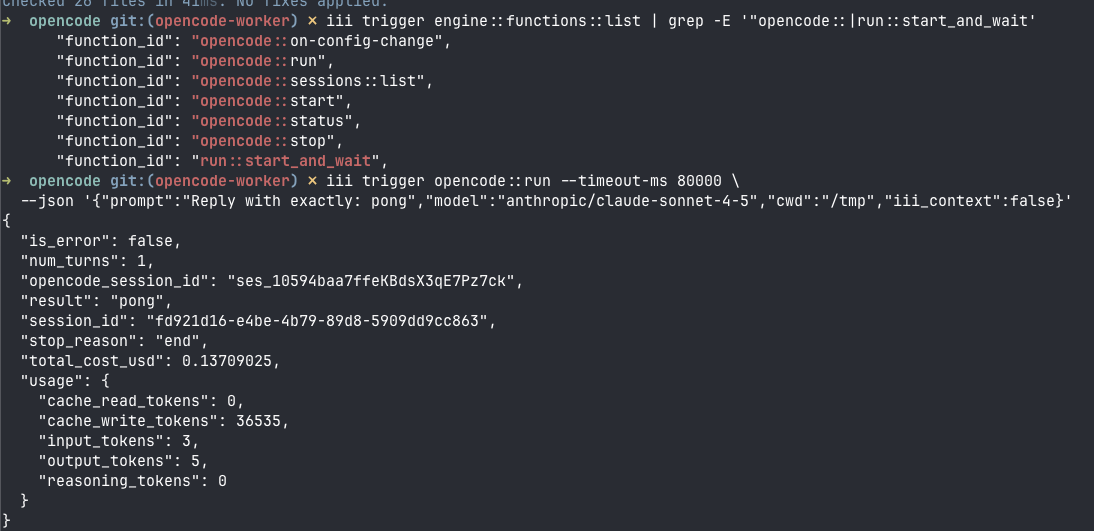
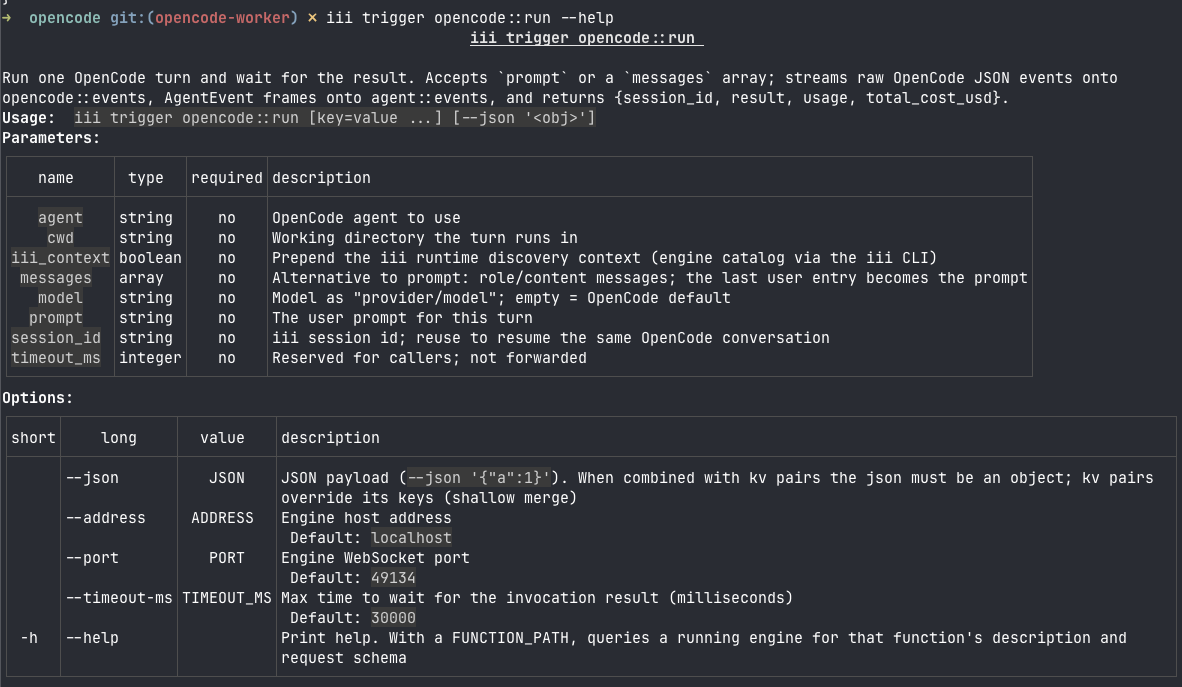
A turn from the CLI returns the result with token usage and cost, and opencode::run --help prints the published request schema as a parameter table:
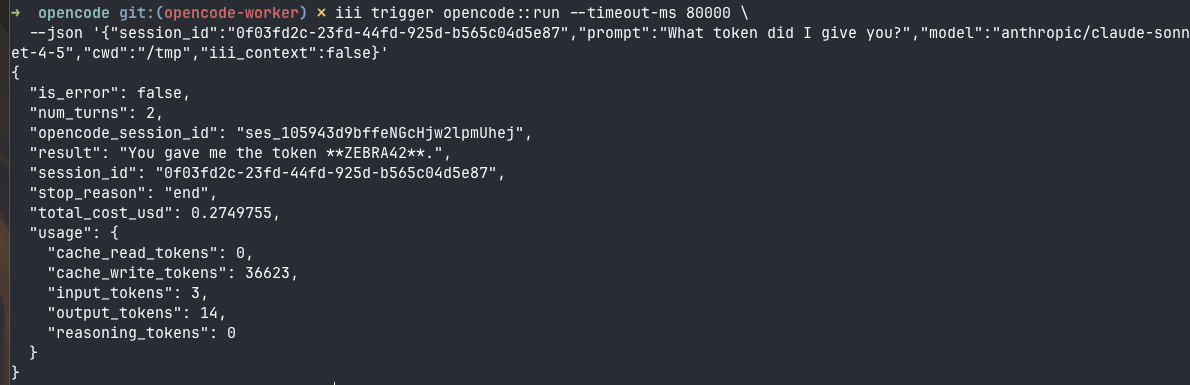
Resume uses the iii session_id, not opencode_session_id. Two ids come back from every run: session_id (a UUID) is the iii key for resume / status / stop and the session_id event feeds are bound with; opencode_session_id (ses_...) is OpenCode's own id, returned for reference only. To continue a conversation, pass the same iii session_id again. The worker looks up the stored OpenCode session for that key and resumes with --session:
Long turns: use opencode::start to return immediately, then observe opencode::on-agent-event with args { session_id } (see Event feeds) for message_complete, function_execution_start/end, and turn_end. opencode::stop interrupts a live run.
Functions
| Function | Purpose |
|---|---|
opencode::run |
Run one turn, wait, return the final result + usage + cost |
opencode::start |
Fire-and-forget turn; progress arrives on opencode::on-agent-event |
opencode::stop |
Interrupt a live run |
opencode::status |
Session state, live flag, usage, cost |
opencode::sessions::list |
All sessions this worker has run |
opencode::run accepts a bare prompt or a messages array ([{ role: 'user', content: [{ type: 'text', text }] }]), plus model (provider/model), cwd, agent, and iii_context overrides.
Events, usage, and cost
Every line OpenCode emits under --format json is delivered verbatim on opencode::on-raw-event, and translated onto opencode::on-agent-event:
| OpenCode event | opencode::on-agent-event |
|---|---|
text |
message_complete |
tool_use (completed) |
function_execution_start + function_execution_end |
step_finish |
token usage + cost, surfaced on agent_end and the return value |
| stream end | turn_end + agent_end |
OpenCode reports per-step tokens (input / output / reasoning / cache read+write) and cost inline in the event stream, so opencode::run returns usage + total_cost_usd with no extra bookkeeping.
Event feeds
The worker hosts two event feeds, private functions it calls once per frame: only this worker calls them, and anyone may observe them.
| Function | Args | Delivery | event in the frame |
|---|---|---|---|
opencode::on-agent-event |
{ session_id } |
iii, to the observers of that session | one translated AgentEvent frame (message_complete, function_execution_start/end, turn_end, agent_end) |
opencode::on-raw-event |
{ session_id } |
iii, to the observers of that session | one raw OpenCode JSON event, verbatim (step_start, text, tool_use, step_finish) |
session_id is the iii session id: required, non-empty and at most 512
characters; the engine rejects any other arg with INVALID_ARGS. Each feed
accepts at most 256 observers; one more is rejected with OBSERVER_LIMIT. A
frame of a session nobody observes is not sent.
iii.observe(
  { function_id: 'opencode::on-agent-event', args: { session_id }, capture: ['output'] },
  'my::on-opencode-event',
  { metadata: { team: 'a' } }, // optional: handed to your function as the metadata sidecar
);
With capture: ['output'] your function receives one call per frame
(fire-and-forget): the Observed envelope, whose output is the frame:
{
  "session_id": "<iii session_id>",
  "event_id": "<session_id>-<epoch>-00000007", // identity, for dedup
  "seq": 7,              // contiguous per (feed, session_id, epoch), from 0
  "epoch": "<uuid>",     // per worker process; a new epoch restarts seq at 0
  "source": "opencode",
  "event": { "type": "message_complete", "...": "..." }
}
The two feeds number their frames independently, and seq advances for every frame, observed or not. Deliveries are not guaranteed to arrive in order, so order by (epoch, seq) and drop repeated event_ids. Frames are ephemeral: nothing is stored or replayed, and an observer added after a frame was emitted never sees it. The durable record of a turn is the value opencode::run returns and the session record behind opencode::status / opencode::sessions::list. The feeds do not use iii-stream (see the guide "Migrate from iii-stream and pubsub"). The acp worker observes opencode::on-agent-event when it drives this worker.
The agent on the bus
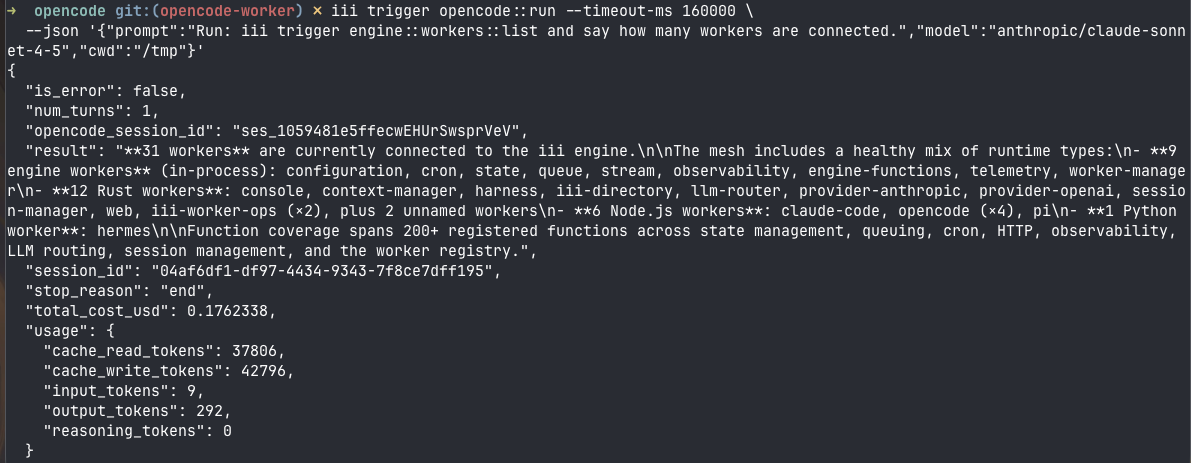
By default every turn's prompt carries the iii runtime context: the engine-grounded discovery rules retargeted to the iii CLI, which OpenCode reaches through its own shell tool. The agent discovers capabilities from the live engine (engine::functions::list, iii call <fn> --help, the registry flow) instead of memory. Local file edits stay on OpenCode's native tools; backend actions go through registered functions. The context is prepended on a fresh session and skipped on resume; turn it off with "iii_context": false per call or in config.yaml.
OpenCode answers by querying the live engine itself, grouping every connected worker by runtime:
Configuration
engine_url: ws://127.0.0.1:49134

defaults:
  model: ""                # empty = OpenCode default; else "provider/model"
  cwd: ""                  # default working directory for runs
  agent: ""                # OpenCode agent; empty = default

iii_context: true                    # prepend the iii runtime context on a fresh session
opencode_executable: ""              # path to the opencode CLI; empty = resolve on PATH
config.yaml is the seed: on first boot the worker registers it with the built-in configuration worker as the initial value, then reads the live value back and hot-reloads on configuration:updated. engine_url stays on the local seed (bootstrap). The event feeds are fixed functions, not configuration; the former events_stream / raw_events_stream keys are accepted and ignored so stored configs keep loading.
How it maps
| OpenCode | iii |
|---|---|
opencode run --format json turn |
opencode::run invocation |
| each JSON event, verbatim | opencode::on-raw-event frame |
text part |
message_complete frame on opencode::on-agent-event |
tool_use part |
function_execution_start / function_execution_end frames |
step_finish tokens + cost |
usage + total_cost_usd on the result + agent_end |
session resume (--session ses_...) |
engine state scope opencode_sessions, keyed by iii session_id |
| extra capability | another iii worker on the bus (shell, database, storage, ...) |